
Mobile & manufactured homes · Panhandle
Mobile home removal, demolition and trailer removal
How do I get rid of an old mobile home in the Panhandle?
Call us. Elite Cleanup handles mobile home removal and demolition across the Texas Panhandle, old trailer removal included: we look at the home and the lot, walk you through the salvage paperwork and utility disconnects, set our dumpsters, manage the tear-down and haul it all away. When we leave, the pad is clear and the lot is picked clean.
Updated
Permits and rules
Sourced. Rules change, so we confirm what applies before every job.
Mobile home salvage paperwork
Under Texas law, a manufactured home that's scrapped, dismantled or destroyed is "salvaged." The owner applies to TDHCA's Manufactured Housing Division for a statement of ownership showing salvage. If there's a lienholder of record, the lien is part of that paperwork.
Source: TDHCA Manufactured Housing — Form 1118, salvaged home procedures
Demolition permit
The City of Amarillo requires a permit from Building Safety before a building is demolished. On our jobs, the partner contractor pulls it.
Gas and electric
In Amarillo, electricity comes from Xcel Energy and natural gas from Atmos Energy. Both get disconnected before any structure comes down. Outside Amarillo, call your utility.
Outside Amarillo
Every city and county sets its own rules. Outside Amarillo, check with your city or county before anything comes down. We'll confirm what applies before the job is scheduled.
- Have the home's title or ownership record handy when we talk. It makes the salvage step quicker.
Who handles what
We handle
- A look at the home, the pad and the road in
- A plain walk-through of the salvage paperwork you file
- Elite Cleanup dumpsters on site for the whole job
- Tear-down of the home, skirting, steps and add-on porches
- Haul-off of the frame, panels, roofing and contents
- Cleanup of the pad: screws, insulation, glass and trim
You decide
- Whether the home is coming down or being moved whole
- What happens to the steel frame and axles
- Anything you're keeping: appliances, windows, the water heater
- Whether sheds, decks or carports on the lot go too
Not part of the job
- Moving a home intact — that's a licensed manufactured-home mover
- Septic system abandonment
- Asbestos abatement, if testing finds any
How it goes
Walk-through
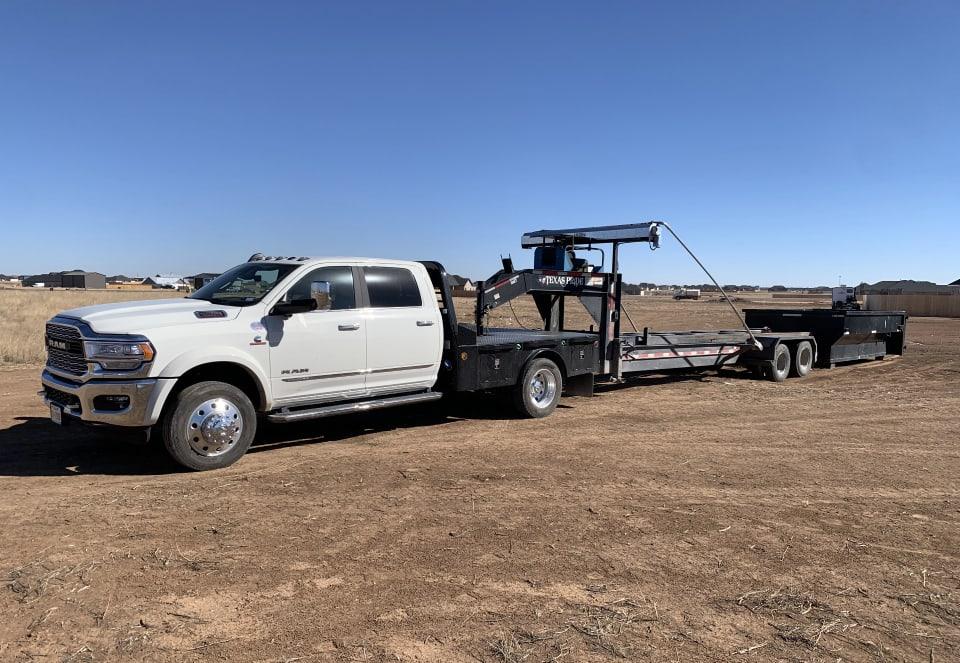
We look at the home, how it sits, and how a truck and trailer get to it. Rural lots are fine; we plan the approach.
Permits and utilities
You file the salvage paperwork as the owner, and the utility disconnects get scheduled. We'll tell you what to have ready.
Dumpster set
A big box goes beside the home. Steel, if it's coming out, is handled separately from the light debris.
The work
Skirting, porches and roofing come off first, then the walls and floor come apart down to the frame.
Haul-off
We swap full boxes and haul every load to a licensed disposal facility.
Final cleanup
We pick the pad clean of screws, nails, insulation and glass, the stuff that hides in the grass for years.
The dumpster for this job
A mobile home is mostly light, bulky material, so it fills a box by volume long before weight is a problem. A 30-yard is the usual starting point. If concrete piers, block or a pad come out, they go in a 15 or 20-yard box: concrete, brick, dirt and stone are only allowed in those two sizes because of truck weight.
| Size | L × W × H | Included | Heavy material | For this job |
|---|---|---|---|---|
| 30-yard | 20 × 7 × 6.5 ft | 15 days · 4 t | No | A single-wide or a double-wide section: panels, roofing, insulation and contents. |
| 25-yard | 16 × 7 × 6.5 ft | 15 days · 3 t | No | Smaller single-wides, or what's left after salvage. |
| 20-yard | 14 × 7 × 5.5 ft | 30 days · 3 t | Yes | Skirting, steps, porches and a concrete pad or piers if they come out. |
Concrete, brick, dirt and stone go in a 15 or 20-yardbox only. Heavy material reaches the truck's weight limit long before it fills a bigger box.
Renting the box on its own? See dumpsters for demolition jobs or compare all four sizes.
Is it cheaper to move it than tear it down?
Sometimes a home in good shape can be sold and moved whole, and that's a job for a licensed manufactured-home mover, not us. If the roof leaks, the floors are soft or the home has sat empty for years, moving it rarely makes sense.
We'll tell you honestly what we see when we look at it. If it should be moved, we'll say so.
What affects the price
- Single-wide or double-wide
- What's still inside the home
- Add-ons: decks, porches, carports, skirting
- Whether piers, block or a concrete pad come out
- The road in and room for the truck to turn
- Distance from Amarillo
Every job is quoted after the walk-through, in writing, with the dumpster and the haul-off in the same number.
Questions we get
Who files the salvage paperwork?
The owner. The state paperwork is in your name, so we can't file it for you, but we'll tell you what it is and when it needs to be done. Our guide on tearing down a mobile home in Texas walks through it.
Who does the tear-down?
Elite Cleanup manages the job and puts our dumpsters on site. The demolition work is done by licensed, insured local contractors we partner with.
Can you get to a home on a rural lot?
Usually, yes. Tell us about the road in, gates and soft ground. A dry caliche drive is fine; we may wait a day after heavy rain.
Tear-down, haul-off, cleanup. One call.
Tell us what's on the site and where it is. We'll walk it, quote the whole job in writing, and set our dumpster before the work starts.