
What has to happen before a house can be torn down in Amarillo?
Three things come before the tear-down. The City of Amarillo requires a demolition permit from Building Safety. Gas from Atmos Energy and electric from Xcel Energy get disconnected, and water and sewer are dealt with. And you settle asbestos: a single house generally needs no DSHS notice, but other buildings coming down with it change that.
1. Decide exactly what's coming out
Write the list before anyone quotes it: the house, and is the slab coming out too? The driveway, the sidewalk, a detached garage, the fence, the trees? Each one changes the permit picture, the dumpster plan and the price.
It also changes the asbestos question. Texas treats one private house on its own differently from a site where other homes or commercial buildings are coming down at the same time.
2. Settle the asbestos question first
Texas DSHS says one private residence isn't subject to the federal asbestos NESHAP rules, and no DSHS notification is required for it. The DSHS demolition decision tree draws the line at a single-family dwelling or a building of four or fewer units, and asks whether other homes or commercial or public buildings on the same site are also coming down. If they are, the house is part of a regulated job.
Commercial and public buildings are different: they need an asbestos inspection, and DSHS must be notified at least 10 working days before demolition starts, even when no asbestos is found.
We don't do asbestos abatement. If asbestos needs to come out, a DSHS-licensed abatement contractor removes it before the demolition starts.
3. Disconnect gas, electric and water
In Amarillo, electricity comes from Xcel Energy and natural gas from Atmos Energy. Both get disconnected before the structure comes down. Call them early: the disconnect has to be done before work starts.
Water and sewer: for a structure the City has declared dangerous, Amarillo requires the taps to be abandoned through the City's Water Distribution Department (806-378-6826) before demolition begins. For any other house, ask Water Distribution what your address needs; we'll ask at the walk-through too.
4. Pull the City permit
Amarillo requires a permit from Building Safety before a building is demolished, and the City's contractor licensing rules add a Lot Clearance Bond requirement for building demolition. On our jobs, the licensed contractor doing the tear-down pulls it.
Building Safety also lets homeowners apply for permits on a residence listed as their homestead exemption with the Potter or Randall appraisal district. Ask the City whether that covers a demolition before you plan on it.
Outside Amarillo, every city and county sets its own rules. Canyon and Borger both require a demolition permit. Elsewhere, check with your city or county.
5. Plan two dumpsters, not one
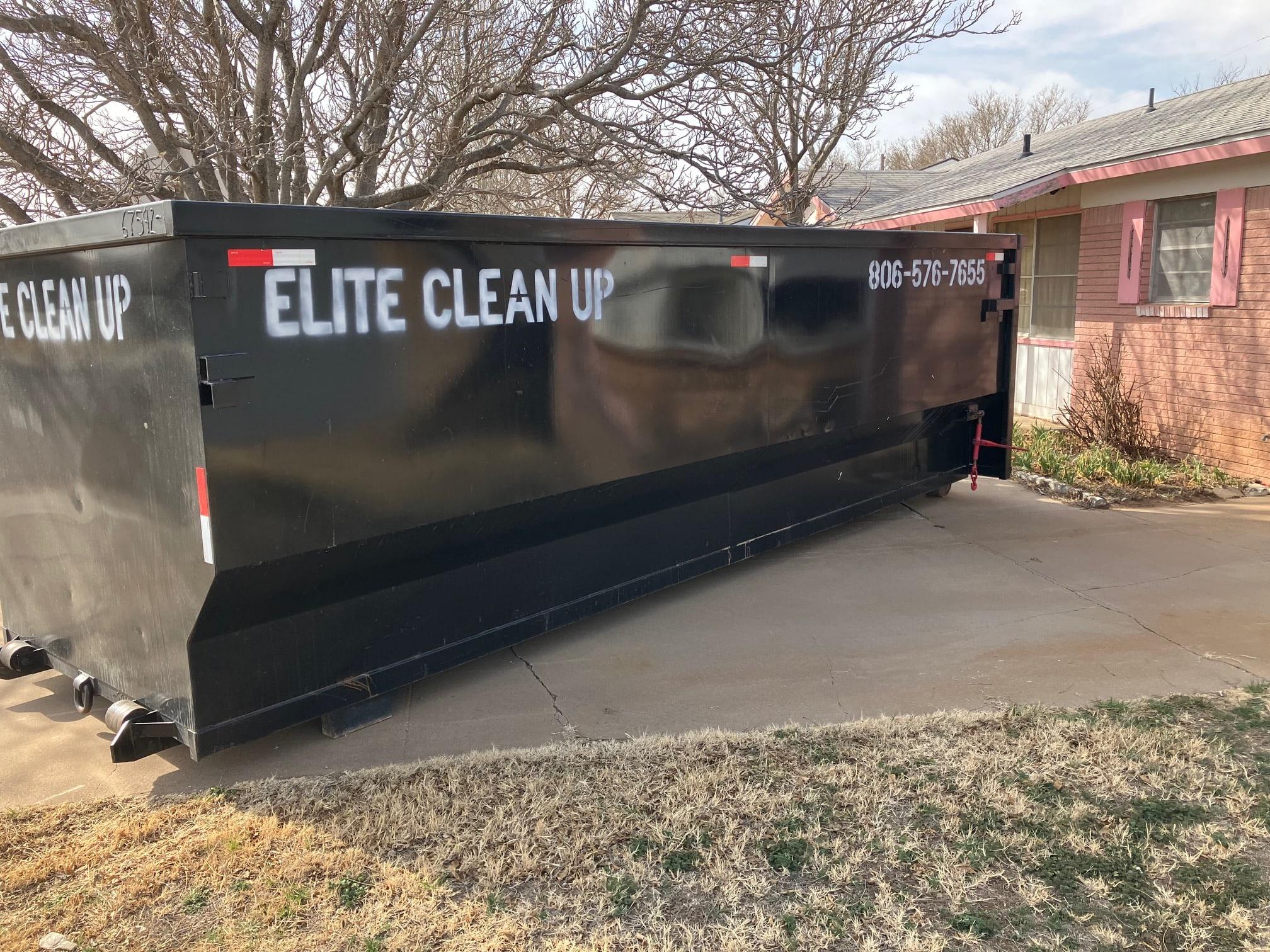
A house is two kinds of debris. Framing, drywall, roofing and whatever's left inside are bulky and fairly light, so they go in a 20 or 30-yard box. The slab, footings, brick and the driveway are heavy, and concrete, brick, dirt and stone only go in a 15 or 20-yard box because of truck weight limits.
We set our own boxes before the tear-down starts and swap them as they fill, so the crew never stops to wait on a haul.
6. Tear-down, haul-off, final cleanup
The demolition crew takes the house down and loads as it goes. We haul every load to a licensed disposal facility, then pick up nails and scraps and rake the lot so it's ready for whatever's next: a new build, a sale or grass.